Saturday, October 18, 2014

It All Began in Boston

As we traveled around Boston these days, we realized again how God used our years in Boston from 1970 -1982 to shape our lives.

For our first two years in the Boston area, we lived in a one-room efficiency student apartment at Andover Newton Theological School. The apartment was already furnished. It measured about 400 sq. ft. and had just enough room for our clothes and books. With a few decorating touches, we made it our own.


Each day Lynn drove to Lexington Christian Academy, which was about an hour away on busy roads filled with temperamental Boston drivers. I went to class and studied. At night, Lynn graded papers and did lesson plans. I went to more classes and studied some more.


At Andover Newton, I was able to pursue training in prison ministry through a field work program at a nearby maximum security prison. Every week, we’d travel to the prison to meet with inmates who were about to be released. After their release, we’d follow up with them on the outside.

I took classes not only at Andover Newton but also at other seminaries in the area. One of my classes focused on counseling alcoholics. It was taught by an Episcopal priest who was himself a recovering alcoholic.

My work in the prison and my experience with alcoholics led me to my first job as the director of a counseling program for alcoholics at The Salvation Army Harbor Light Center in Boston.


The Harbor Light Center was located in the area of Boston where homeless and street people congregated. The Center offered a 30-bed temporary shelter for men, a 10-bed temporary shelter for women as well as a 60-bed alcohol rehabilitation program for both men and women.

Daily contact with so many poor, homeless, and addicted people had its effect on us. They taught us honesty and patience. They forced us to exercise and stretch our faith. They made us examine our values and the culture that shaped us. We loved many of these people. Some of them loved us back. As a result, our lives changed.

We were also privileged to work with some wonderful staff, including two African American women whom we met during our visit to Boston. 


Jaqui was my administrative assistant for most of the time I served as executive director of the Harbor Light Center. Sandra joined our staff as the manager of our homeless shelter. Both of these women remained on staff at the Harbor Light Center after I left. Jaqui worked there for 31 years, Sandra for 30 years. Working for this many years in a setting that has uncommonly high levels of pressure and stress is an amazing testimony to their resilience and faith. Sadly, both Jaqui and Sandra lost their jobs when the Center closed for financial reasons about seven years ago. Both have struggled financially since then. Both have lost people close to them. Sandra has had to overcome two different types of cancer. 

Sandra and Jaqui have many reasons to be burned out, frustrated, angry. But, they are filled with faith. The joy in the faces of these two women when we met together overwhelmed us. They truly are saints whose lives have touched hundreds of people with hope and who have served the Lord in some of the most difficult circumstances and conditions to be found anywhere.

After two years in seminary housing and two years in a third-floor walk-up apartment near Lexington Christian Academy, we settled into a three-family house in Hyde Park in southeast Boston. We raised both of our babies in this house, which was to be our home for the rest of our time in New England.

Lynn was a stay-at-home mom who became involved in local women’s Bible studies and, in time, started to work out of our home as a freelance editor. I traveled by bus and subway to Harbor Light Center each day and often on weekends.

After four years on staff at Harbor Light Center, The Salvation Army asked me to serve as the executive director of the Center. This involved the oversight of 25 staff from many different racial and ethnic backgrounds. It forced me to develop new skills in budget management, fundraising, community relations and strategic planning. On Sundays, it brought our entire family to the Center to lead worship services for residents and elderly people in the area.

On the Sundays that we did not have responsibilities at the Harbor Light Center, we attended services at Park Street Church in downtown Boston. Park Street Church was where we were members and where both of our kids were baptized. The church was home to many students and a large group of internationals. As one of the oldest churches in the U.S., it had a huge commitment to missionary support and to faithful exegetical preaching.


We were able to attend a Sunday worship service at Park Street Church during our visit to Boston. As we heard the magnificent organ and joined the congregation in singing, we choked up and stopped singing. Our eyes filled with tears at the memories of the services we had attended at Part Street while we lived in Boston.
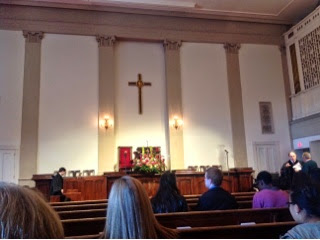

It was at Park Street Church that we attended our first week-long missions conference. It was there that God touched our hearts to serve the poor internationally. It was there that we first heard about World Relief. It was there Lynn took a course taught by J. Christy Wilson at the Boston Center for Christian Studies and learned about tent-making mission strategy. It was there that Lynn worked with our first refugee family.

Our involvement with Park Street Church opened our eyes to the world outside of the U.S. As a result, we felt led to pursue missionary service overseas, where poverty and human need was so much greater for many people than in the U.S. To gain access to these countries, I felt led to pursue an MBA in health care management on a part-time basis at Boston University.


So, I quit my full-time job at the Harbor Light Center and took on a number of part-time jobs--working for a friend at his local seafood restaurant business, serving as a pastor at a small church in our community, working as the weekend administrator at Boston City Hospital, consulting to The Salvation Army.

As I approached the end of my studies at Boston University’s School of Management, I accepted a position as Director of Administration and Personnel with World Relief, which was located in Wheaton, Illinois.  As  result, we had to leave Boston for a new life in a Chicago suburb.

It was very hard for us to leave Boston. We loved the area. We loved the people. We had many friends and many wonderful memories. But, we clearly felt God’s leading to go, and so we uprooted our family and ourselves and moved away.

But, Boston had changed us. We arrived in Boston with each other, our faith, and only those things that we could carry in the back of our old Ford sedan.

We left with such riches in terms of family, friends, experiences, and careers. Our views of the world, of service to others, of missions, and of God’s faithfulness had been enlarged and forever changed.

Now, 44 years later, we thank God for taking us to Boston. During these many years, we have had a wonderful journey filled with blessing and joy.

And, it all began in Boston.

Thursday, October 16, 2014

Wicked Good Accents

We love to hear people in New England talk.

"These clayums were dug this mawhning. Just boil them in theyah own juice. They'll be wicked good," said the 70-year-old, grizzled lobsterman who had just sold us 5 pounds of freshly dug clams from a little shack on the back of his property.

"I'll be right theyah," screeched a woman from a second-floor window, when we rang a bell to register for a campsite. A few minutes later, she yelled, "I'm right heeyah." Coming into view, she apologized for her delay. "I was in the showah. I still need to fix my hayah." Telling us which site was ours, she said, "You can pahk your van right ovah theyah."

As we travel through New Hampshire and Maine, Lynn and I are always so delighted to hear the New England accents. We can't get enough of it, engaging native speakers in extended conversations whenever we can.

"That'll be one lawbstah stew and one chowdah," said the waitress when she took our order. "And do you want any beeyah to go with that?" Of course we did. With that accent, how could we say no?

We knew we'd love the foliage, the beautiful coastline, and the quaint villages with their white homes and steepled churches in New England. But, we'd forgotten how much we would enjoy hearing local people talk. 


Or, is that pronounced "tahk?"

The woman who changed the oil in our van asked, "Five quahts? Shoowah, deah."


Even the emergency signs on the road have an accent. "Make yah ma proud," said the flashing sign on the freeway, followed by "wear yah seat belts."

And those r's that seem to disappear. Well, they sometimes reappear in the strangest places. One of Lynn's students, Marcia Abbott, was referred to as Mash-uh-rabbit.

Or a seminary student who lived next door to us in married-student housing told us that he was taking a course: "The Church in the Morden Age." Nope, that's not a typo. The r just migrated.

The New England accent is starting to grow on us. Ahs move. In other cases, consonants simply just disappeah. And vowels nevah sound like we expect.  

Take the town neah wheyah we ah staying. It's not "Gloucester," it's


These wonderful New England accents. They ah just wicked good.


But accents are not the only wicked good thing in New England.


Tuesday, October 14, 2014

The Second-best Sundaes We Ever Ate

They were absolutely the best sundaes we every ate. Forty-two years ago, at Cabot’s Ice Cream in Newton, Massachusetts.

Lynn and I had moved to Newton at the end of the summer so that I could attend seminary in Newton. Lynn was teaching English at Lexington Christian Academy.

We didn’t have much money, so we did not often indulge ourselves. But, some seminary friends invited us to go to Cabot’s, an ice cream store with fabulous sundaes, and we joined them.

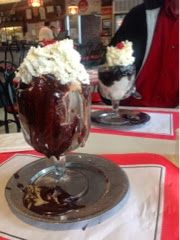
The menu offered 32 favors of ice cream and 42 kinds of toppings. When the sundaes arrived, we were speechless. They were huge. They were magnificent. Each one included two very large scoops of freshly made Cabot’s ice cream, topped with a thick gooey hot fudge sauce, whipped cream, and a cherry. The sundae was so large that the topping ran down the side of the glass.

When the sundaes arrived, all conversation stopped. We didn’t know what to do first. Spoon off the whipped cream on the top of the sundae? Catch the topping that was dripping down the side of the glass before it hit the table? Sample one or both of the scoops of ice cream we had ordered?

We immediately tried to do all three. Then when we had finished the whipped cream, salvaged the dripping sauce, and made a dent in the ice cream, we passed the glasses around so that others could sample our ice cream and appreciate the fact that we had selected the most delicious options.

Finally, the bottom of the glass appeared. Then, it was time to eat the cherry, carefully protected for this final moment. When the cherry was gone and the last drops of ice cream and chocolate sauce were carefully scraped from the bottom of the glass, we gave a big sigh and looked up. Now, it was safe to talk again. 

During our recent trip to the Boston area, we visited the town of Newton to see where we had lived and where I had gone to seminary. And, somehow, we found our way to Cabot’s.

When we arrived, we were so pleased to see that it was still there, 42 years later. There were the same booths and the same round tables. Most important, the menu at Cabot’s said it still served the same sundaes.


We don't eat many sundaes anymore. Too much sugar, too many calories, too much fat for people our age. But, when we returned to Cabot’s after 42 years, we simply had to try the sundaes again. 

With some uneasiness, we sat down and ordered our sundaes. Would they be as good as we had remembered? Maybe they’d be less flavorful, smaller, generic?

We ordered two sundaes. One with Death by Chocolate and Coffee Almond Fudge ice cream topped with hot peanut butter fudge.  The other was Cherry Vanilla and Mint Chocolate Chip ice cream topped with hot bittersweet chocolate. Both sundaes had whipped cream, and, of course, both came with a cherry on the top.


When we started on our sundaes, we stopped talking. Time seemed to stand still. All we could focus on was salvaging the hot sauce dripping down the side of the glass and enjoying the richness of the ice cream we had chosen.


When we had gotten things under control and the chocolate and ice cream was at about the mid-point in our glasses, we did the traditional sundae exchange. "Wow," we said, "this is truly as good as we remembered it.”  Exchanging sundaes again, we resumed eating and didn't stop until we had carefully spooned out the last drops of ice cream and chocolate sauce from the bottom of the glass.

The first sundaes we had at Cabot’s 42 years ago were the best we had ever eaten. With the passage of time, they have taken on a larger-than-life, almost mythical presence in our memories. Nothing could top them.

But, the sundaes we had on our recent visit to Cabot were really, really good. They truly had to be the second best sundaes we ever ate.

Monday, October 13, 2014

The Reunion

Day 53--The class of 1974. 

Forty-four years ago, when I (Lynn) began teaching English at Lexington Christian Academy (LCA), the class of 1974 were 9th graders. They were my first class. There were around 30 students in the grade, and I taught them in two different sections--one of 16 students, the other of 14. It was a teacher's dream to have such small classes. 

We met for class in Room 103. Wanting to create an informal setting for learning, I arranged the desks into a circle for many of our classes, and I sat in one of the student desks in the circle as well. I created bright-yellow bulletin boards on which I hung colorful posters of e. e. cummings poetry. After all, this was the early seventies. 

Every day I made myself a pot of tea in a bright orange tea pot and offered tea to the students if they wanted to join me. 


One of my chief goals as an English teacher was to teach students how to write well. How to think through the content of a paper before writing it by creating an outline of their ideas. How to use words effectively. How to write concisely and clearly. 

They wrote. And wrote. And wrote some more.

I read and commented on papers. And read. And read some more. 


When the class were 11th graders, I was their American English teacher. Because several students in the class were exceptionally gifted, a colleague and I designed and taught an Advanced Placement English class for them when they were 12th graders.

By the time the class graduated, I knew I was pregnant with our first child and I knew I would not be returning to the school to teach. So, I left LCA with the class of 1974.


About a month ago Bas and I learned that the class of 1974 were going to gather at the school for a 40th reunion. When some of the students invited us to join them, we rearranged our schedule so that we could spend time with them.  

What a thrill it was to see the students again and to meet their spouses. Forty years ago, I knew that many of them held great promise. To hear who they have become and what they had accomplished in those forty years was a profound blessing. 

Of the 29 students in the class when they graduated, three of them had died. Nine of them were able to attend the reunion. I was impressed that several of them had traveled a great distance--from Colorado, Arizona, Michigan, and Maryland--to share this night together. 


During our tour of the school, which has expanded and grown tremendously in the four decades, we stopped in Room 103. There were no yellow bulletin boards. No desks in a circle. No bright orange tea pot. 

But we talked about what happened for us in that room. One student said she is so glad that she was forced to write so much. She is now a sales executive with a software company, and writing copy is a major part of her job. She even edits others' copy. Another student is now a cardiac surgeon who has published many articles about his work and research. If I closed my eyes, I could still see their distinct handwriting on their papers. I even remembered the topics of some of their thesis papers.


After a few hours at the school, we joined each other for dinner, where we spent another few hours catching up. I was struck by how much these former students still care for each other and by how much they value the time they had together at LCA. More than one of them remarked that they were disappointed that they did not find in college the kind of close relationships they had had at LCA. 

I left the restaurant feeling very proud of these men and women, blessed to have shared in their journeys. 

The class of 1974. They were my first class. They were my last class. 

They were my favorite class. 

Saturday, October 11, 2014

What Goes Around Comes Around

Day 52--We've known Jenna since she was a baby. Jenna's parents are Dave and Nancy, whom we had just seen in Essex. Jenna's family lived near ours in Hyde Park, Massachusetts, and we spent lots of time together. Our daughter, Alisa, and Jenna, three months apart in age, have been friends all of their lives. Even though they now live on opposite coasts, they still have a rich relationship.

It has been 10 years since we last saw Jenna. She was living in Oakland, California, working for an urban mission organization and investing in the lives of at-risk teenage girls. She had a passion for Christ and a passion for the poor. Those passions eventually took her to Kenya, where she worked at a mission hospital. It was there that she met and fell in love with Dexter, who is now her husband. 

While living in Kenya, they gave birth to their son, Kyalo (pronounced CHA-lo). A year later they moved to the States so that Dexter could attend dental school and become certified to practice dentistry in the US. After graduating in the spring, he accepted a job at a dental clinic in South Paris, Maine.


We had "met" Dexter and Kyalo only through Jenna's blog, so it was a treat to spend an evening with them. Kyalo is a delightful three-year-old--engaging, bright, happy, creative, cuddly. He radiates joy, and he loves life. He loves his baby sister.  He loves his "Bible." And he's already an avid Red Sox fan. Smart boy.


Kyalo also loves his one-month old baby sister, Malaikah Grace (pronounced Ma-LIKE-ah, which means "Angel" in Swahili). Malaikah is the youngest person we have met on our road trip to this point. 


While sipping Dexter's Kenyan chai and munching on Jenna's chocolate-chip-pumpkin muffins, we heard about their move from New Jersey to Maine, about Malaikah's birth, about the new friends they are making in South Paris. As we talked, Dexter cuddled Malaikah, very comfortable with his newborn daughter. He's clearly a natural father, very engaged with both of their young children.


It was fun to share Jenna-and-Alisa stories with Dexter. Thirty-two years ago Jenna and Alisa were Kyalo's age, and the two of them got into lots of mischief together. It is always amusing to read Jenna's blog and to hear her exasperation about some of the things Kyalo does. What goes around comes around.

It's not just michievousness that comes around. When we saw Jenna's love and care for her children and her husband, it was great to see that the grace, faith, and love that her parents invested in her have "come around" as well. 

We're seeing that a lot on this trip. Blessing and faithfulness from one generation to another. 

In the lives of so many of our friends and their children, it's heartening to know that what goes around truly does come around.

Friday, October 10, 2014

The Turning Point

For the past 50 days, we have been continually heading east.

On a few occasions, we've gone north or south to see friends or some special sights. But, our general direction has always been east.

Until today.

Today, we visited Bar Harbor, Maine, a beautiful town on the outskirts of Acadia National Park on Mt. Desert Island. As we left Bar Harbor, for the first time in almost two months, we turned west.


We're almost at the halfway point in our trip. We've gone as far east as we can go. 

We've reached a turning point.


In the days ahead, we'll travel south to visit more friends and to explore parts of the country we have never seen before.

But, eventually we will turn west.


West toward home. 


West toward our normal lives. 

West toward the future. 

Going east has been fun. Going south will be interesting.

But, at the end of the day, going west will be good.


Wednesday, October 8, 2014

More Snapshots of Maine

Day 49--Enjoy these glimpses of the Maine coast of Acadia National Park and other parts of Mount Desert Island.

The rugged coast:


The view from the top of Cadillac Mountain:

The snug harbors


Bas(s) Harbor Lighthouse:


Afternoon tea and popovers at the Jordan Pond House:


Lobstermen emptying and sorting their lobsters:

The ever-present bursts of color: